





28May
The 2013 Infinity European Open, Philippsburg, Germany
Shooting in Production Division Frank Garcia was one of the USA Competitors
As the IPSC European Handgun Championship and World Shoot XVII take place in 2013 and 2014 respectively, the bigger matches being held in the European IPSC area in 2013 will give European competitors the opportunity to meet up and compete together. The match organisers took on the big task of allowing 345 shooters to start the match. Over the past 12 years, this event has established itself as one of the premier IPSC matches in Europe.
The 2013 Infinity European Open, Philippsburg, Germany
The 2013 Infinity European Open, Philippsburg, Germany
As the IPSC European Handgun Championship and World Shoot XVII take place in 2013 and 2014 respectively, the bigger matches being held in the European IPSC area in 2013 will give European competitors the opportunity to meet up and compete together. The match organisers took on the big task of allowing 345 shooters to start the match. There were also many competitors from outside European countries, such as Canada, Israel, Russia, South Africa and the USA. These competitors can see how European matches are organised and to participate in such a match as part of their training in preparation for future events, such as the European Championship, which takes place in Portugal in September this year. Over the past 12 years, the event in Philippsburg, Germany has established itself as one of the premier IPSC matches in Europe.
The USA’s Brooke Sevigny came in third place in Lady’s Open Division.
As with the Mediterranean Cup, Denmark’s Rooster Mountain, the Czech Extreme and French Nationals, the Infinity European Open is one of the “to do” Level III matches on the European IPSC competition circuit. This year’s event was organised by Jurgen Ofner and Patrick Kummer and their team of helpers. This was a well designed match, as all the stages proved to be very testing on each competitor’s abilities.
From Sweden STI European Team member Ralf Jensen finished
in fifth place in Standard Division.
Philippsburg Complex
Philippsburg ComplexThe range complex at Philippsburg is probably among the best club ranges in Europe. They have been constructed on a former Bundeswehr military firing range complex, which became surplus to military requirements at the end of the Cold War. You have overhead protection from the elements and the semi open range construction, with 180 degree backstops and multiple portable bullet traps allow designers to build and shoot any stage imaginable. There are numerous wide 25 meter ranges and two huge 50 meter ranges give the space needed to build any number of stages. All stages give the competitors overhead protection from sun or rain and the sand floored ranges have overhead sound baffling that also lets in a lot of daylight. This facility can easily handle a match of this size. The pistol ranges surround a 300 metre rifle range. The design of this complex means that rifle shooting is able to continue over the same weekend that the Infinity Open was taking place. The IPSC European Championship was held at this facility in 2001 and building and range development work continues. Developments since last years match included tracks that were previously dirt and stone have now been paved. The complex plans to have a gun shop on site by next year.
Using her 9mm Sphinx 3000 Production pistol Switzerland’s Christine Burkhalter
finished in second place in Lady’s Production Division.
Held over the 17th – 19th May this year's Infinity European Open offered 18 stages ( plus chronograph ), to shooters from 26 IPSC Regions. The range officers and match organisation staff shot the pre match, which allows them to run the competitors through the match on the Saturday and Sunday.
18 Stage Match
18 Stage MatchThis year the round count was 346 rounds for 18 stages, with each competitors shooting ten stages on the Saturday and eight stages on the Sunday. There were nine short stages up to 12 rounds, six medium stages of 22 to 24 rounds and three 32 round long stages. Nine stages offered 22 plus rounds or more, so there were points to be gained on most stages. This match attracted many of Europe’s top practical pistol shooters across all IPSC Divisions. As this match is probably the most technical on the European match circuit this competition is a tough challenge.
From France STI European Team member Emile Obriot finished
in second place with 99.01 % in Open Division.
Analysing the 324 competitors who completed the match shows trends which are taking place in IPSC matches Europe. Open and Production Divisions had 105 ( 32.4 % ) and 106 shooters ( 32.7 % ). Standard Divisions had 88 competitors ( 27.2 % ). Revolver Division and the new Classic Division have their devotees with 10 ( 3.1 % ) and 15 ( 4.6 % ) shooters respectively in each Division.
Dave and Brooke Sevigny were two of the contingent of competitors from Canada and the USA.
Participating in the match were Bill Drummond, Brent Lorton, Brooke and David Sevigny, Demetrios Katos, Frank Garcia and KC Eusebio from the USA and Jean Philippe Drolet from Canada. Andre Saaiman and Paul Keaney came all the way from South Africa and Guga Ribas from Brazil. Slightly closer were Dudi Ram, Dotan Toibis, Yael Dagan and Yoav Shavit from Israel.
Yael Dagan was one of the group of competitors from IPSC Israel
and finished in fifth place in Ladies Open Division.
Stage Design
Stage DesignThis is always a demanding and technical match with the need for both accurate shooting and thinking. There were also both paper and steel targets out to 30 to 40 meters, lots of 10 to 25 meter targets, with many of these partial targets or with no shoots targets obscuring much of the shoot targets. The stage designers cleverly allowed the shooters the tactical choice of whether to shoot long distance or run up closer to the targets. You could shoot a steel target at a longer range, which activated a moving target, so the mover had slowed down a bit by the time you reached it. So there were stages designed to suit all levels of competitors. Lots of stages had small square steel plates and partial targets, which added to the need for accuracy even on the shorter distances.
The Czech Republic’s Robin Sebo took second place in Production Division.
As well as shooting targets downrange, there were also many to the left and right. With 180 degree back stops and portable rubber faced steel bullet stops the stage designs could easily vary the direction of fire. Cleverly positioned barricades and windows forced the shooter to move quickly and adopt different shooting positions while shooting the stage. Lots of moving targets added sophistication and a degree of difficulty to many of the stages. There were swingers, bobbers and drop and turn targets. This match has among the most activated targets as any Level III IPSC Match in Europe. Fourteen of the 18 stages had moving targets. Only two stages did not have any steel targets. Four stages had small steel targets that moved up and down or from side to side. The stage designs were very good. The high accuracy requirements also added a lot to the match as well.
Representing Team Glock KC Eusebio took third place in Open Division.
Stage 18 was a 32 round field match with steel and paper targets out to 40 metres. In Stage One as the competitor advanced down the range they broke an optical sensor which released two 15 cm square steel plates which appeared and disappeared from behind hard cover. In stages were optical and electronic sensors are used there is always the worry that they will break down, but in these two stages this equipment worked properly throughout the match.
With the demise of Modified Division Guga Ribas now competes in
Production Division with his 9mm x 21mm Sphinx SPD Production.
Match Results
Match ResultsOpen Division winner of the match, with just under a one percent margin, was STI European Team member Saul Kirsch. STI European Team member Emile Obriot ( 99.01 % ) and KC Eusebio from Team Glock ( 92.38 % ) came in second and third. In Standard Division Dave Sevigny from the USA took the top spot, with Canadian and Hungarian competitors Jean Philippe Drolet ( 98.47 % ) and Gyorgy Batki ( 95.79 % ) in second and third place. Speaking to Dave he told me that winning Standard Division really pleased him as had spent the previous several weeks practicing and competing in Single Stack competitions at home.
From the Netherlands STI European Team member Saul Kirsch
finished in first place in Open Division
The USA’s Dave Sevigny took first place in Standard Division, which pleased him
as he has spend the previous few weeks practicing for Single Stack events.
In Production Division Eric Grauffel took the top place, using his Tanfoglio pistol. Eric dominated Open Division for many years and is now in his second season in Production Division. Eric will be shooting in Production Division at the 2013 Europeans. From the Czech Republic Robin Sebo ( 88.24 % ) and Miroslav Zapletal ( 85.94 % ) took second and third place. The top junior in Production Division was Russia’s Pavel Torgashov, who also finished in fifth place overall. Watching Pavel shooting a few stages I think that this could be a name that we can keep an eye on for the future.
Current Open Division World Champion Eric Grauffel is now in his second season in
Production Division. Dominating Open Division for many years
he is now also at the top of Production Division.
Two cases eject from Pavel Torgashov’s CZ Shadow. From Russia Pavel was the
top placed junior in Production Division and also finished in fifth place overall.
In Revolver Division first place went to Germany’s Markus Schneider. Germany’s Sascha Back
( 92.63 % ), who is the current European Revolver Champion and Volkhard Kliner ( 90.18 % ) were in second and third place. In Classic Division Germany’s Patrick Kummer won using a 9mm calibre STI M1911. Just over 1 % separated the USA’s Brent Lorton and Germany’s Steven Kummer in second and third place.
Using a STI single stack in 9mm calibre Patrick Kummer took first place in Classic Division.
Ladies Category
Ladies CategoryIn the Ladies Open Division Holland’s Desiree Van Noord came first, with the Czech Republic’s Lenka Horejsi and the USA’s Brooke Sevigny in second and third place respectively. In Standard Division Germany’s Petra Tutschke, Sandra Schuh and Lisa Mariack-Kraft took the first, second and third place. In Production Division Russia’s Svetlana Nikolaeva came in first place with Switzerland’s Christine Burkhalter and Denmark’s Norah Josephsen in second and third place respectively.
Lenka Horejsi from the Czech Republic finished in second place in
Ladies Open Division with her STI competition pistol.
Russia’s Svetlana Nikolaeva was the first placed Lady in
Production Division with her CZ Shadow.
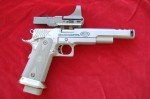
Each year after the awards for the top placed competitors there is a random draw for a series of prizes, which includes a pistol. For 2013 this was a Infinity pistol in .40 S&W calibre with a AET bull barrel, three sided slide, xcelerator serrations and steel signature grip. The pistol was provided by Germany's SV Infinity distributor Juergen Flass ( www.svi-flass.de ). This years winner was Thierry Codenie from Belgium. His friend won the prize pistol last year!
This years winner in the prize draw for the Infinity pistol was Thierry Codenie
from Belgium. Thierry is flanked by Juergen Flass, Germany’s SV Infinity distributor
and match organiser Patrick Kummer.
This has always been a successful event due to the effort from a dedicated group of individuals who make it happen. Many of the top IPSC competitors in Europe across all the Divisions were present. The match ran smoothly to the posted schedule, even with some squads containing up to 14 competitors, due to the hard work of the range crew. The standard of the ROing was very positive and the match is supported by an excellent web site.
The organisers of the 2013 Infinity European Open ran an excellent competition and here’s looking forward to the next one. To see the full set of results and information about the match, visit the competition web sites.
For Further Information
www.ipscmatch.de
www.infinity-open.de